



Man, as is evidenced by his teeth, was created graminivorous, as well as carnivorous, and the earliest skull yet found possesses teeth exactly the same as modern man, the carnivorous teeth not being bigger, whilst in many cases the whole of the teeth have been worn down, as if by masticating hard substances, such as parched grain.
The History of Bread From Pre-historic to Modern Times CHAPTER I. PRE-HISTORIC BREAD
Man, as is evidenced by his teeth, was created graminivorous, as well as carnivorous, and the earliest skull yet found possesses teeth exactly the same as modern man, the carnivorous teeth not being bigger, whilst in many cases the whole of the teeth have been worn down, as if by masticating hard substances, such as parched grain.
In the history of bread, the lake dwellings of Switzerland are most useful, as from them we can gather the cereals their inhabitants used, their bread, and the implements with which they crushed the corn. The men who lived in them are the earliest known civilised inhabitants of Europe-by which I mean that they cultivated several kinds of cereals-wove cloth, made mats, baskets, and fishing nets, and, besides, baked bread.
The cereals known to us, and made use of, are the result of much cultivation, improved by selection;14 and Hallett's pedigree wheat would be hardly recognised when put by the side of its humble progenitor of pre-historic times. We now use wheat, barley, oats, Indian corn or maize, rye, rice, millet, and Guinea corn, or Indian millet, besides such odds and ends as the sea lyme grass (Elymus arenarius), which, though uncultivated, affords seed which is used in Iceland as a food, for want of something better.
We have been enabled to trace with certainty the cereals used by pre-historic man, as they have been found lying in the lake mud, or buried under a bed of peat several feet thick, when they had to be collected out of a soft, dark-coloured mud, which formed the ancient lake-bottom, and is now called the relic bed. Dr. Oswald Heer, in his Treatise on the Plants of the Lake Dwellings, says: 'Stones and pottery, domestic implements and charcoal ashes, grains of corn and bones, lie together in a confused mass. And yet they are by no means spread regularly over the bottom, but are frequently found in patches. The places where bones are plentiful, where the seeds of raspberries and blackberries, and the stones of sloes and cherries are found in heaps, probably indicate where there were holes in the wooden platform, through which the refuse was thrown into the lake; whilst those places where burnt fruits, bread, and plaited and woven cloth are found, indicate the position of store rooms in the very places where they were burnt, and thus the contents fell into the water. The burnt fruits and seeds, therefore, unquestionably belong to the age of the lake dwellings; and a portion of them15 are in very good preservation, for the process of burning has not essentially changed their form. Many of the remains of plants, however, have been preserved in an unburnt state.'
He gives the following list of cereals that have been found, and it is a somewhat extensive one: '(1) Small lake-dwelling barley (Hordeum hexastichum sanctum), (2) Compact six-rowed barley (Hordeum hexastichum densum), (3) Two-rowed barley (Hordeum distichum), (4) Small lake-dwelling wheat (Triticum vulgare antiquorum), (5) Beardless compact wheat (Triticum vulgare compactum muticum), (6) Egyptian wheat (Triticum turgidum), (7) Spelt (Triticum spelta), (8) Two-grained wheat (Triticum dicoccum), (9) One-grained wheat (Triticum monococcum), (10) Rye (Secale cereale), (11) Oat (Avena sativa), (12) Millet (Panicum miliaceum), and (13) Italian millet (Setaria Italicum).'
Of these Nos. 1 and 4 were the most ancient, most important, and most generally cultivated, and next to them come Nos. 5, 12, and 13. Nos. 6, 8, and 9 were, probably, like No. 3, only cultivated, as experiments, in a few places. Nos. 7 and 11 appeared later, not until the Bronze Age, whilst No. 10 (rye) was entirely unknown amongst the lake dwellings of Switzerland.
At the lake settlement at Wangen a remarkable quantity of charred corn was dug up. Mr. L?hle believes that, altogether, and at various times, he has collected as much as 100 bushels. Sometimes he found the entire ears, at other times the grain only. Any of my readers can see for themselves16 some of this wheat, and also some raspberry seeds, found at Wangen. In the same case in the Prehistoric Saloon of the British Museum may be seen specimens of beans, peas, charred straw, acorns, hazel nuts, barley in the ear, millet in ear, in seed, and made into cakes, one showing the pattern of the bottom of a basket, and another the impress of a rush mat. The cakes or bread of millet are very solid, and are made of meal coarsely crushed.
We know how this was crushed, for we have found their corn-crushers and mealing-stones. Of these the rude corn-crushers are undoubtedly the earliest. These stones, with their rounded ends, for a time somewhat puzzled the arch?ologist as to their use; but that was at once apparent when they were taken in conjunction with the hollowed stones. They were corn-crushers, which were used for pounding the parched corn or raw grain to make a thick gruel or porridge.
Later on they improved upon them by using mealing-stones, which ground out the meal by rubbing one stone on another, accompanied with pressure. The stones are in the British Museum. Such mealing-stones were used by the Egyptians and Assyrians, as we shall see, and are employed to this day in Central Africa. 'The mill consists of a block of granite, syenite, or even mica schist, 15in. or 18in. square and five or six thick, with a piece of quartz or other hard rock about the size of a half-brick, one side of which has a convex surface, and fits into a concave hollow in the larger, and stationary, stone. The workwoman, kneeling, grasps this upper 17
18millstone with both hands, and works it backwards and forwards in the hollow of the lower millstone, in the same way that a baker works his dough, when pressing it and pushing from him. The weight of the person is brought to bear on the movable stone, and while it is pressed and pushed forwards and backwards one hand supplies, every now and then, a little grain, to be thus at first bruised, and then ground on the lower stone, which is placed on the slope, so that the meal, when ground, falls on to a skin or mat spread for the purpose. This is, perhaps, the most primitive form of mill, and anterior to that in Oriental countries, where two women grind at one mill, and may have been that used by Sarah of old when she entertained the angels.'
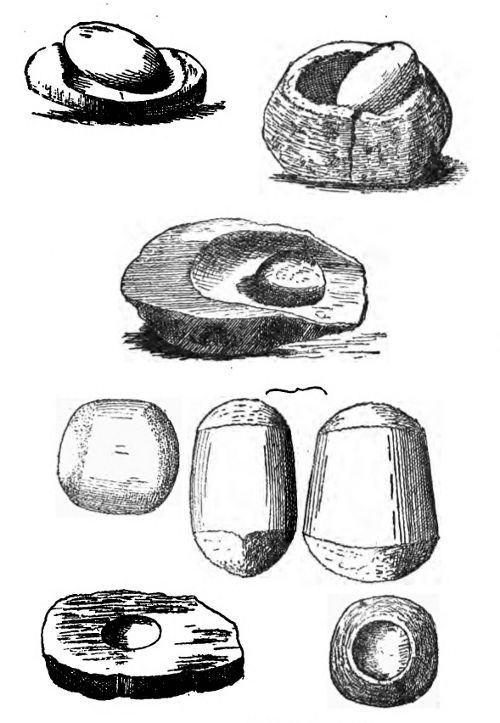
Pre-Historic Mills and Corn-Crushers.
To these mealing-stones succeeded the quern. This was a basin, or hollowed stone, with another-oviform-for grinding. The quern has survived to this day. In London, at the west end of Cheapside, by Paternoster Row, was a church, destroyed by the Great Fire of 1666, and never rebuilt, called St. Michael le Quern. It was close by Panyer Alley, so called from the baker's basket, and a stone is still in the alley on which is sculptured a naked boy sitting on a panyer. Querns have been found in the remains of the lake dwellings in Switzerland, and in the Crannoges, or lake dwellings of Scotland and Ireland. They are still in use in out-of-the-way places in Norway, in remote districts in Ireland, and some parts of the western islands of Scotland. In the latter 19country, as early as 1284, an effort was made by the Legislature to supersede the quern by the water-mill, the use of the former being prohibited, except in case of storm, or where there was a lack of mills of the new species. Whoever used the quern was to 'gif the threttein measure as multer2;' and the transgressor was to 'time3 his hand mylnes perpetuallie.' Querns were not always made of stone, for one made of oak was found in 1831, whilst removing Blair Drummond Moss. It is 19 in. in height by 14 in. in diameter, and the centre is hollowed about a foot, so as to form a mortar.
To sum up this notice of pre-historic bread, I may mention that at Robenhausen, Meisskomer discovered 8lbs. weight of bread, and also at Wangen has been found baked bread or cake made of crushed corn exactly similar. Of course, it has been burnt, or charred, and thus these interesting specimens have been preserved to the present day. The form of these cakes is somewhat round, and about an inch to an inch and a half thick; one small specimen, nearly perfect, is about four or five i
/0/1652/coverbig.jpg?v=20171122145459&imageMogr2/format/webp) The History of Bread From Pre-historic to Modern Times
John Ashton
History
The History of Bread From Pre-historic to Modern Times
John Ashton
History
CHAPTER I. PRE-HISTORIC BREAD
17/11/2017
CHAPTER II. CORN IN EGYPT AND ASSYRIA
17/11/2017
CHAPTER III. BREAD IN PALESTINE
17/11/2017
CHAPTER IV. THE BREAD OF THE CLASSIC LANDS
17/11/2017
CHAPTER V. BREAD IN EASTERN LANDS
17/11/2017
CHAPTER VI. BREAD IN EUROPE AND AMERICA
17/11/2017
CHAPTER VII. Early English Bread
17/11/2017
CHAPTER VIII. HOW GRAIN BECOMES FLOUR
17/11/2017
CHAPTER IX. THE MILLER AND HIS TOLLS
17/11/2017
CHAPTER X. BREAD MAKING AND BAKING
17/11/2017
CHAPTER XI. OVENS ANCIENT AND MODERN
17/11/2017
CHAPTER XII. THE RELIGIOUS USE OF BREAD
17/11/2017
CHAPTER XIII. GINGER BREAD AND CHARITY BREAD
17/11/2017
CHAPTER XIV. BREAD RIOTS
17/11/2017
CHAPTER XV. LEGENDS ABOUT BREAD
17/11/2017